//]]>
random

عنوان الموضوع

نبذة عن الموضوع

عنوان الموضوع

نبذة عن الموضوع

عنوان الموضوع

نبذة عن الموضوع

عنوان الموضوع

نبذة عن الموضوع

عنوان الموضوع

نبذة عن الموضوع

التسميات

‏إظهار الرسائل ذات التسميات Phones. إظهار كافة الرسائل

الخميس، 21 يوليو 2016

iPad Pro 9.7


The iPad Pro 9.7in, Apple's appealing new mid-size tablet, proves that while laptops might still be the best tool for working on the go, they're no longer necessary. In our 9.7-inch iPad Pro review, we evaluate the new iPad Pro's build quality and new features, put the device through our rigorous speed benchmarks and battery-life tests, and compare the value for money the 9.7-inch iPad Pro offers compared to other iPads (and rival tablets) on the market


iPad Pro 9.7in review

Welcome to Macworld's iPad Pro 9.7in review for the UK. If you'd prefer a larger-screen tablet, read our iPad Pro 12.9in review.
Apple unveiled a new mid-size iPad at its 'Let us loop you in' March press event, as we expected, but what we didn't expect was for this to be an iPad Pro. Rather than calling this the iPad Air 3, which it logically and visually appears to be, Apple is presenting it as a shrunk-down version of the 12.9in iPad Pro - and thereby attempting to position the new 9.7-inch iPad Pro as a work device suitable for replacing a laptop, and targeted particularly at designers and illustrators on the go.
But does it succeed? In our iPad Pro 9.7in review, we evaluate the latest iPad's design and build quality, weigh up the pros and cons of its new features, put the device through the Macworld labs' most rigorous speed benchmark and battery tests, and compare the value for money that the iPad Pro 9.7in offers compared to the other tablets on the market.
This is a general review of the iPad Pro 9.7in, but many of its prospective buyers will be digital artists, illustrators and designers keen to make the most of its compatibility with the Apple Pencil. If that includes you, then also take a look at the more design-focused review by our colleagues at Digital Arts.
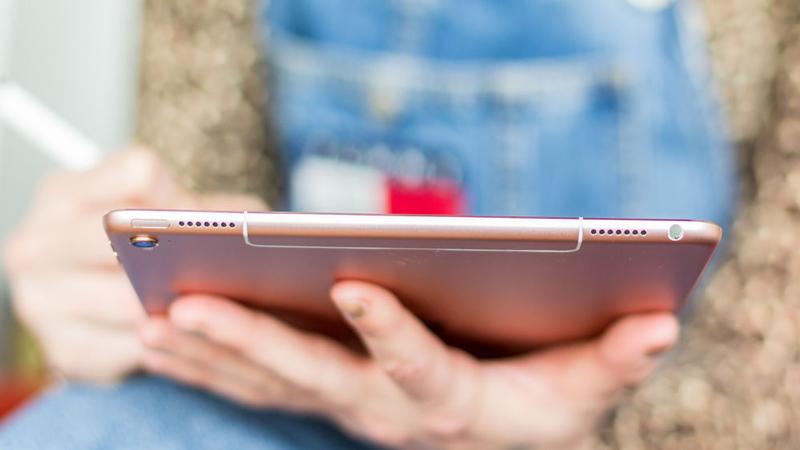
iPad Pro 9.7in review: Summary of review

Design: Physically the iPad Pro 9.7 is a close match to the iPad Air 2: weight and dimensions are identical, as is the general design (which remains sumptuous, of course). You now get four speakers - two at the top, two at the bottom - and the bottom speakers are spaced slightly further apart. This results in a much fuller, richer sound - not exactly surround sound, but a far more immersive audio experience than we've come to expect from a tablet. Read more about the iPad Pro 9.7in's design
Cameras: One other noticeable physical change is the rear-facing camera, which now sticks out and will scratch on the desk if you lay the iPad flat on its back. Slightly annoying, that, although any sort of case will remove this issue, and you do get the payoff of a heavily enhanced camera setup. The rear-facing camera now has a flash, and has been pushed from 8 megapixels (on the Air 2 and the Pro 12.9in) to 12Mp; there are also numerous smaller improvements to this component.
The front-facing camera is even more dramatically boosted, going from 1.2Mp to 5Mp and gaining the Retina flash feature. We look at all this in more detail, and present a selection of test shots and comparisons, in the camera testing section, but suffice it to say that in some conditions you won't notice the difference from the Air 2's cameras, in others you'll notice small improvements, and in others it's in a whole different class. Read more about the iPad Pro 9.7in's camera performance
Screen: The 9.7-inch touchscreen Retina-class display is in most respects the same as that on the Air 2: same size, same resolution and pixel density, same sharply responsive multitouch functionality. But it adds a new (and optional) feature called True Tone, designed to subtly adjust the screen's colour output to account for environmental light conditions. And we do mean subtly - it's a similar kind of idea to Night Shift, producing a warmer, yellower colour palette under electric lighting, but to a much less noticeable degree. We imagine most users will only be dimly aware that the screen seems to have good colour output without being sure why; we saw a clear difference only by sitting it next to the (non-True Tone) iPad Air 2 in various conditions.Read more about the iPad Pro 9.7in's screen
Speed: Thanks to its A9X processor chip, the Pro 9.7 is significantly faster - at least on paper - than the Air 2, and in most tests very nearly as quick as the iPad Pro 12.9 despite having half as much RAM. For the time being you won't notice much difference between the Pros and Air 2, but the older device is sure to get left behind as more and more processor-intensive apps and games are released with the newest generation of hardware in mind.Read more about the iPad Pro 9.7in's speed benchmark tests
Battery: Early battery testing was also impressive, with the Pro 9.7 lasting, surprisingly, an average of 11hrs, 2m in GeekBench 3's highly demanding benchmark despite having slightly lower battery capacity than the Air 2 (which managed just 7hrs 40m). Both devices should last longer than that in general use. Read more about the iPad Pro 9.7in's battery performance

Accessories: Crucially for its credibility as a laptop replacement, the Pro 9.7 has launched alongside a new keyboard case, a 9.7in version of the Smart Keyboard, and like the Pro 12.9 it features a port on its lefthand edge for connecting to and powering this accessory. It's about as good as an ultraportable keyboard of its size could be, but nowhere near as accurate to type on as a conventional keyboard (and some way behind the larger 12.9 version of the Smart Keyboard, too). It does a job, but you'll need to rely on either a solid autocorrect (like the one in Pages), frequent manual corrections, or just lots of practice.
You can also now use the Apple Pencil stylus, which is pretty wonderful, but expensive. Read more about the iPad Pro 9.7in's accessories
UK pricing: The Pro 9.7in starts at £499 in the UK, with prices rising to £839 for the 256GB cellular model. You're paying a premium, then, and many Apple fans will baulk at the asking price. But we think there are enough enhancements here to justify it, and business users - if they can live with the smaller and harder-to-use keyboard attachment - will get a lot out of this device. It's still a cool £180 cheaper than the Pro 12.9, remember, and that device doesn't get the True Tone display or most of the camera upgrades. Read more about the iPad Pro 9.7in's UK pricing
That's the summary of our iPad Pro 9.7 review, but let's look again at each of those areas in more detail - before finally giving our definitive verdict.


Samsung Galaxy Tab S2 9.7

The new tablet high-end Samsung entered. After a Galaxy Tab S, which had become one of the great successes of 2014 slate, Tab S2 arises out of the night with a different format and a new design for a kind of upmarket Galaxy Tab A.

CHARACTERISTICS


Système d'exploitation  ;     Android

Version d'OS testée     ;     Android 5.1

Puce mobile    ;    Exynos 5433

Processeur    ;    4 x ARM Cortex A57 + 4 x A53 1.9 GHz

Nombre de cœurs   ;       8

GPU intégré (iGPU)  ;     Mali-T760 MP6

Mémoire vive (RAM) ;          3 Go

Ecran     ;        9.7 pouces Amoled Capacitif

Définition     ;    2048 x 1536 pixels

Mémoire interne / carte SDHC  ;    32 Go / non / oui

Autonomie    ;       Capacité de la batterie

5870 mAh  ;         Dimensions / Poids

169 x 237.3 x 5.6 mm / 389 g     Wi-Fi / Bluetooth / 3G / 4G (LTE)

PRESENTATION

After deciding to compete with Apple in front on smartphones with GS6 and variations deal with iPhone 6, both on the technical side as commercial, Samsung launches into a similar battle against the iPad and iPad Mini with Galaxy Tab S2 9.7 and 7.9 with similar formats. A battle already begun with the release of the Galaxy Tab A, also in these formats, but without the high-end side.

The Galaxy Tab 9.7-inch S2 interest here has a screen Super AMOLED panel with 24.6 cm diagonal in 4: 3 and the definition of 2048 x 1536 px (against 26.7 cm 4:10 p.m. to 2560 x 1600 px on the Galaxy Tab S). It also embeds a mobile chip octo-heart house Exynos 5433 (quad-heart ARM Cortex-A57 clocked at 1.9 GHz quad-heart + ARM Cortex-A53 1.3GHz), RAM 3GB, a storage capacity of 32 or 64 GB expandable through the addition of a microSD card, a photo-video sensor 8MP rear and another 2.1 megapixel front, a fingerprint reader and a battery of 5870 mAh for supplying all energy. Wi-Fi a / b / g / n / ac and Bluetooth 4.0 are the large piece of wireless connectivity. There is no GPS in this Tab S2.

The user interface is provided by Android 5.0.2 Lollipop, completely covered from own TouchWiz system and so dear to the Korean brand.

The tablet Samsung Galaxy Tab S2 9.7 inches is sold from 499 €.

ERGONOMICS

If the first Galaxy Tab S 10.5 was intended as an XXL version of the Galaxy S5 flagship smartphone, the Galaxy Tab S2 borrows nothing at Galaxy S6. The new Samsung slate will instead tap into the intermediate design emerged from the Galaxy Alpha and more visibly on the Galaxy Note 4 and finally democratized the mobile Galaxy A. Galaxy Tab S2 is the big sister in size, these devices and however displays as the thinnest tablet of the world, on its thinnest portion (the photo sensor exceeds a hair), with 5.6 mm thick.


If the metal could be sometimes a majority in the building of the latter, the Tab S2 remains measured on this point and adopts as its perimeter, adding a small chrome edging. The product is lightweight and relatively compact for its size and therefore knows how to be discreet in a bag and practice in hand. We are still waiting and still however a brand goes on Apple land with a neutral touch point on the screen to enter the product of a hand with a thumb on the slab, without canceling the touch 
interaction other fingers.

The fingerprint reader provides the same operation that Galaxy S6 or a 4 rating, placing the finger rather than the slippery, as the proposed (unfortunately) the Tab S and the GS5. The result is a more ergonomic use, accurate and fast.


As with other Samsung devices with identical or even the iPad before it, this reader quickly becomes indispensable for fast unlocking the screen.


As for downsides, because there's start with the most trivial or most, namely finishing the perimeter. The edges are carved and some can potentially hinder the user on the palms. However, this is largely mitigated by the light weight of the animal. Another note, assembly back is not 100% uniform. Without apparently achieve product integrity, we would have liked a little more care with the finish on a high end product set. Note the two small circles on the back, chrome and, like the Tab S, sink and simply can accommodate the fastening system of the Samsung official cases for its slate

SCREEN

The slab Super AMOLED 9.7-inch Tab S2 sees this definition "drop" 2048 x 1536 px (2560 x 1600 against the Tab S), which allows him to still keep a resolution of 264 dpi, sufficient for clear display texts in particular. The maximum brightness is 376 cd / m², which is very decent for this technology takes advantage of a virtually infinite contrast to compensate. The result is visibility outdoors blameless. We measured a reflection rate of 8%, which places the Tab S2 among the good pupils in the class.


In terms of colorimetry, the Tab S2 does more than defend. The mode of "basic" display, which shows the most faithful to the great majority of Samsung devices with multiple display modes, we measured a Delta E of 2.2 reflecting accurate colors. The color temperature is stable and close to the standard to 6640 K.

This display is not without reproach, because we measured a delay of 99 ms touch above the average of our comparative and this time far from 9 ms measured on the iPad Air 2, the master material. In essence, the slab Super AMOLED of the Galaxy Tab S2 is still built on the same top step than the Apple slate. Two tablets that offer the best market display today.

PHOTO

Le capteur reste à 8 Mpx, comme sur la première itération de la Tab S, mais les résultats sont moins convaincants. Le niveau des détails est correct au centre, mais le lissage se fait plus présent sur les bords. Surtout, les couleurs se montrent bien plus ternes et les clichés manquent clairement de chaleur par rapport à la première Tab S et à un iPad Air 2. La mise au point et le déclenchement sont plutôt rapides, mais il n'est pas rare d'obtenir des images floues pour autant. Une stabilisation aurait été bienvenue. En basse lumière, les performances auraient pu être bonnes, si le contraste avait été un peu plus élevé et — encore une fois — les couleurs moins ternes. Le bruit électronique reste contenu, mais on est tout de même loin de pouvoir exploiter ces photos. À noter aussi qu'entre la Tab S et la Tab S2, le flash LED s'est perdu en route


Those tempted to make videos with this Tab S2 can do to Full HD. Focus continuously as the extent of exposure are well managed by smooth transitions. The final report suffers however from the same reproaches for the photo.
Find the Samsung Galaxy S2 in our Face to Face Photo
The front sensor of 2.1 megapixels do not particularly excels. The level of detail does not reach the heights that seems to be trying to counter the tablet by contrast enhancement not necessarily very happy. Smoothing applied to the image - out "beauty" way - to limit the damage in terms of noise. Suffice it in for videoconferencing, but fans of selfies will not be at the party. In this register, one prefers the Xperia Tablet Z Sony or iPad Air 2.

Samsung Galaxy S7

The Samsung Galaxy S7 off again on the basis of a slab Super AMOLED 5.1-inch WQHD resolution (2560 x 1440 px) causing a very comfortable resolution of 576 dpi. For years, the Snapdragon SoC 820 has been tipped to equip the GS7 but in Europe at least, it is a house solution chosen by Samsung, in this case a Exynos Octa 8 8890. It is based on a processor quartet ARM Cortex-A53 at 1.6 GHz and a second group of 4 processors M1 Exynos 2.3 GHz. At that, this SoC adds 4GB of RAM and a Mali-T880 MP12 iGPU to 12 treatment units. The internal memory of 32GB especially sees the return of the microSD port.

Samsung has chosen to spend 16 to 12.2MP for the main sensor and remains at 5MP for front module. The battery sees its capacity increase to 3000 mAh, while the GS7 is the first terminal of the brand out immediately on Android 6.0 Marshmallow. Connectivity includes WiFi, Bluetooth 4.1, NFC and 4G LTE (cat 12/13 to 600/150 Mb / s). Another feature reappeared: resistance to water and dust proof (IP68).

The Samsung Galaxy S7 has launched code and costs € 699.

Samsung a quelque peu modifié son fer de lance dans la forme. Le S7 perd très légèrement en hauteur et en largeur et paraît ainsi plus élancé que son prédécesseur. Surtout, l'accentuation de l'aspect bombé de la vitre avant joue les trompe-l'œil en faisant paraître les bordures moins épaisses. L'écran occupe une part plus importante de la face avant du terminal (72,7 % contre un peu plus de 71 % auparavant), ce qui permet une plus grande liberté d'action à une seule main... les deux mains étant tout de même nécessaires pour bon nombre d'usages.

The back side undergoes however a more pronounced change. Here we find a back bent at the edges which gives added comfort to grip, the back side better matching the palm. The glass used for its looks less slippery hand and gives a secure grip. The circumference is only slightly modified and 
retains its pleasant touch metal.


Image Capture

The Galaxy S7 thus inaugurates a sensor 12.2MP, adorned with an optical aperture of f / 1.7 and a stabilized focus Dual Pixel AF system. This brings an advantage, that of responsiveness. Indeed, the GS7 is the quickest smartphone to do the development. Especially as the ultra-fast autofocus is not hampered by the image processing, also almost instantaneous. It is possible to "strafe" without the 
camera will weaken, while maintaining clear images.

الثلاثاء، 19 يوليو 2016

iPhone 7

iPhone 7


Apple won't release its next-generation iPhone until the fall of 2016, so there are still months of development ahead. For the current time, Apple's flagship iPhones are the iPhone 6s and the iPhone 6s Plus, released to the public in September of 2015.
Though it will be several months before the new iPhone 7 launches, rumors about the device started trickling out in January of 2016. We've already gleaned many details about the upcoming iPhone, giving us plenty of information on what to expect when it debuts.
Since the 3GS launched in 2009, Apple has used an alternating "S" naming formula to mark years where the iPhone does not receive a major redesign, saving its numbered upgrades for years where design changes are introduced. Releases have been as follows:
2007 - iPhone

2008 - iPhone 3G

2009 - iPhone 3GS

2010 - iPhone 4 (new design)
2011 - iPhone 4s
2012 - iPhone 5 (new design)
2013 - iPhone 5s
2014 - iPhone 6 and iPhone 6 Plus (new design)
2015 - iPhone 6s and iPhone 6s Plus

The next-generation iPhone is expected to be called the iPhone 7, but there have been some rumors suggesting Apple could drop its standard numbered naming convention, instead calling the 2016 iPhone the "iPhone Pro." It is unclear at this point if those rumors are accurate.
Because 2015 marked an "S" iPhone upgrade year that introduced new features such as an improved camera and a better processor, 2016 will bring an even-year upgrade that will include a new iPhone design in addition to new features.
Apple will continue releasing two versions of each iPhone, so we can expect to see an iPhone 7 and an iPhone 7 Plus in 2016. Apple is said to be planning to stick to the 4.7- and 5.5-inch screen sizes it first introduced with the iPhone 6 and 6 Plus.
Apple is still working on finalizing the iPhone 7's body so we don't know exactly what it will look like, but multiple rumors suggest it will be a modest update that continues to use a design similar to the design of the iPhone 6s. It is said to have the same general shape as the iPhone 6s, but it may have a camera that protrudes less (though rumors currently disagree on this point). Antenna bands across the back of the device have been removed, but are expected to remain at the top, bottom, and sides of the iPhone. The front of the iPhone is also expected to see some changes with a longer earpiece cutout and relocated ambient light sensor


Some rumors suggest Apple is aiming to make the iPhone 7 up to 1mm thinner, perhaps through theremoval of the 3.5mm headphone jack and the implementation of a thinner Lightning port, but other rumors suggest the iPhone 7 and 7 Plus will have a body that is the same thickness as the iPhone 6s.
With no headphone jack, wired headphones will connect to the iPhone 7 using its Lightning port and Bluetooth headphones will connect wirelessly. Apple is rumored to be working on Lightning-equipped EarPods to sell alongside the iPhone 7. The removal of the headphone jack may also improve water resistance.
Blueprints and an image of a device said to be the iPhone 7 Plus have surfaced depicting a Smart Connector on the back of the shell, suggesting that is another potential feature, but it is not yet clear what it would be used for and other rumors have said it will not be included. If the Smart Connector rumors are accurate, it appears it will be a feature limited to the larger-screened model.
Internal specs for the iPhone 7 aren't yet known, but we can speculate Apple will continue on its path of introducing more powerful, efficient devices with each design iteration. The iPhone 7 and iPhone 7 Plus are expected to include next-generation A10 processors manufactured by TSMC. Internal storage space is getting a boost, with entry-level devices expected to start at 32GB instead of 16GB.
There are rumored to be some distinguishing features between the iPhone 7 and the larger-screened iPhone 7 Plus. The iPhone 7 may ship with 2GB RAM, while the iPhone 7 Plus could include 3GB RAM, and there is said to be a different camera system in the iPhone 7 Plus that uses two cameras instead of one with 2-3x optical zoom and improved performance in low-light conditions. The iPhone 7 will likely continue to use a standard single-lens camera as multiple sources have said the dual lens camera is exclusive to the 5.5-inch iPhone.
All in all, the iPhone 7 is expected to feature only minor changes, which has led to speculation and rumors suggesting demand for the 2016 device will be weak due to a "lack of innovation."

 Design

The iPhone 7 may be somewhat thinner than the iPhone 6s, but exactly how thin remains in question. Apple may use the elimination of the headphone jack, advances in chip packing technology, and a slimmer Lightning port to cut down on the thickness of the device. One rumor has suggested the iPhone 7 will be between 6.0mm and 6.5mm, but leaked renderings and cases do not appear to depict a device that thin, and design drawings from Japanese magazine MacFan feature no reduction in thickness at all.
Information obtained by MacRumors and confirmed by additional reports indicates the iPhone 7's body will be similar to the iPhone 6s, adopting the same general design language.
Apple is planning to change the design of the antenna bands on the device, doing away with the thick white antenna bands that are located across the back of the Phone 6s rear shell. The bands located at the top, bottom, and sides of the device are rumored to remain on the iPhone 7, but the rear bands are eliminated for a cleaner look. As for the thinner Lightning port, while Apple plans to slim it down, it will continue to be compatible with existing the Lightning connector and Lightning cables.

A mockup of what the iPhone 7 may look like. It is said to have a design similar to the iPhone 6s, with a slightly thinner body and no antenna bands across the middle of device's rear shell.
Rumors on the rear camera have varied. Some rumors point towards a camera that protrudes less or not at all, while an image of an alleged iPhone 7 Plus features a camera that continues to protrude. The iPhone 7 will feature a larger camera sensor while the iPhone 7 Plus will include a dual-lens camera.
Some unconfirmed rumors about the iPhone 7's design suggest it could have a strengthened, water resistant frame that ditches Apple's traditional aluminum casing for "new compound materials while also incorporating a touch sensitive Home button, but some of these rumors do not mesh with information pointing towards minor design changes. Improved water resistance is expected due to the removal of the headphone jack.
One rumor from the Asian supply chain said Apple will introduce a new deep blue color option, which will replace the traditional Space Gray shade that Apple has used for several years
Japanese site Mac Otakara, the source of the rumor, later said that a mistake was made and the alleged deep blue shade is actually a new shade of Space Gray. The new Space Gray color is said to be "close to black, but not quite black," and "much darker" than the Space Gray used for the iPhone 6s. A rendering of a dark Space Gray iPhone shows what a deeper color might look like

CAMERA

The cameras in the dual-lens iPhone 7 Plus may take advantage of technology Apple acquired through the purchase of Israeli camera company LinX Imaging last year. Image quality in the iPhone 7 Plus could be greatly improved with the introduction of a dual-lens system, narrowing the gap between photos taken with the iPhone and those taken with a more robust DSLR cameras.

LinX dual-lens technology offers several potential benefits for the iPhone 7 Plus, with rumors specifically pointing towards 2-3x optical zoom capabilities, perhaps implemented through the use of two lenses with different focal lengths. With a dual-lens camera system, images captured are clearer and brighter with less noise and truer color, allowing for pictures that include more detail, especially in low light conditions.


There's a possibility that a dual-lens system like the one LinX created could be used for depth mapping, allowing users to do things like take 3D scans of real world items or use depth information to refocus an image. For additional information on what LinX technology could mean for the iPhone 7, make sure tocheck out our in-depth LinX post.
An example of how a dual-lens camera could potentially improve photos taken with the iPhone 7 Plus can be seen in the below video demonstration of similar technology from Corephotonics. Corephotonics' dual-lens system uses a wide-angle lens and a lens capable of 5X optical zoom and aggregates data from both to get a better picture.

.

Twitter Delicious Facebook Digg Stumbleupon Favorites More